Secret Identity and Identity Confusion
The Secret of ChimneysSecret identities and mistaken identities are not incidental disguises in the novel: they shape how political information travels, how suspects are identified, and how the investigation’s apparent facts must be revised. Anthony Cade’s use of James McGrath’s name begins as a practical arrangement, while the name Count Stanislaus conceals the identity of a murdered guest. Later, recognition itself becomes evidence, and an apparent French colleague is exposed as an impostor whose deception depends on keeping everyone else in the dark.
Names as Practical Cover
Anthony arrives in London travelling under the name of his friend James McGrath, whose passage has been booked under that name. The arrangement is presented as an expedient rather than an elaborate transformation: Anthony notes that the two men look unlike, but might nevertheless share a conventional police description—six feet tall, brown hair, blue eyes, and ordinary features. A name can therefore carry the authority of documents and bookings even when the person using it does not resemble its owner.
The difference between the expected arrival and the actual one gives the borrowed identity practical value. George Lomax receives the wrong arrival information after Bill Eversleigh’s inaudible pronunciation leads a shipping clerk to mistake the Granarth Castle for the Carnfrae Castle. While George plans around James McGrath’s expected Thursday arrival, Anthony has already reached Southampton aboard the Granarth Castle and taken the boat train to London on Tuesday. The narrative lets the reader see the discrepancy before George does: the official name attached to a traveller and the mistaken timetable jointly produce an information gap.
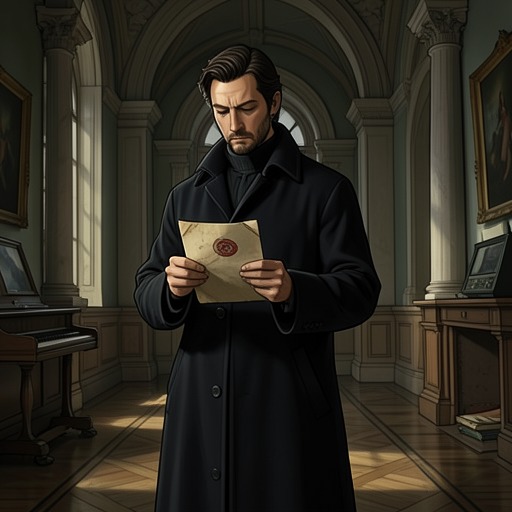
Anthony eventually uses the same name to create a written account of his departure. From the Blitz Hotel, having booked a room as Anthony Cade, he writes that he arrived on Tuesday, handed the manuscript to Balderson and Hodgkins, and is leaving England. He signs the letter James McGrath, then marks the transition to his own name as an exit and entrance. The letter is not merely a false statement; it gives the borrowed identity a documentary trail, making it appear that James has completed the business and gone away while Anthony can act openly under his own name.
A Political Secret Behind a False Name
The memoirs’ route also depends on a concealed chain of custody. George explains that they were secretly conveyed away from Paris weeks before their author’s death and sent to a man called Jimmy, or James, McGrath, a Canadian then in Africa. The report makes the manuscript’s destination sound established, but it identifies the recipient by the name under which Anthony will arrive, not by the traveller’s actual identity. The distinction links a political secret to an ordinary-looking personal alias.
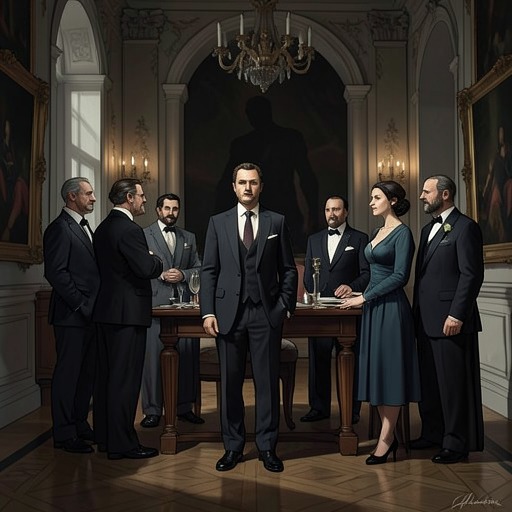
The investigation’s first account of the murdered guest repeats the same problem in more consequential form. Lord Caterham, struggling to supply the name by which the household knew the dead man, says it was Count Stanislaus. Battle immediately distinguishes the name used in the household from the man’s real name and asks whether the title was genuine. George answers that it was not. What initially looks like a settled identification is thus explicitly downgraded to a household label, and the investigation must proceed with the knowledge that the victim’s apparent identity cannot be trusted.
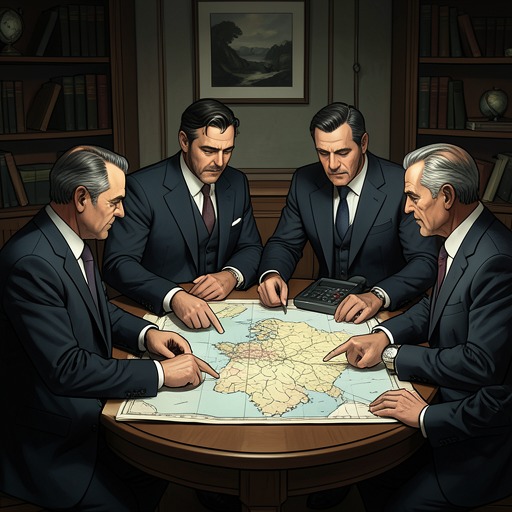
The concealed identity has political as well as forensic consequences. Battle tells George Lomax and Herman Isaacstein that they, along with the Loyalist party of Herzoslovakia, are in serious difficulty. The warning places the investigation’s secret information within a network of government, finance, and political allegiance: withholding identities and facts may protect a plan temporarily, but it also leaves the people relying on secrecy exposed when the concealed truth becomes relevant to the case.
Recognition, Evidence, and Controlled Disclosure
When Battle presents Anthony with a sheet bearing an image, Anthony’s startled recognition becomes evidence. Battle notices the reaction and asks whether he recognizes the man. Anthony confirms that he has seen him before, but specifies that the earlier encounter was not as Prince Michael Obolovitch: the man had claimed to represent Balderson and Hodgkins and called himself Mr Holmes. The two names attached to one person turn a past business encounter into a clue about the dead prince’s movements and deception. Recognition is useful, but only once Anthony supplies the context that makes it meaningful.
The book also makes secrecy a contested practice among investigators and their associates. Virginia argues that George’s insistence on keeping matters dark cannot continue indefinitely and that those already drawn into the affair may cause harm if they stumble upon its secret unaided. Battle agrees that Bill Eversleigh, as George’s secretary, has no reason to be excluded from what needs to be known, and says Anthony has been brought into the affair whether willingly or not and has a right to understand the situation. Disclosure here is not a simple opposite of deception: it is a decision about who can safely act with partial knowledge, and whether secrecy protects the investigation or makes its participants less capable of helping.
The episode in which Anthony and Bundle stroll to the lake gives this information exchange a quieter setting. They go down together, and Anthony proposes that business be addressed before pleasure, turning the walk into an occasion for questions. The scene’s ordinary companionship contrasts with the elaborate concealments elsewhere: knowledge is negotiated directly between people whose involvement has already crossed the boundary between official inquiry and personal association.
Imposture and the Reversal of Suspicion
Anthony’s later explanation of the Dover episode describes mistaken identity as a deliberate tactic rather than a clerical accident. He says that he went to Dover and that Hiram Fish followed him, believing Anthony to be King Victor. At the hideout they found a mysterious prisoner; hearing the prisoner’s account disclosed the pattern: the real man had been kidnapped, while an impostor—in this instance King Victor himself—had taken his place. The deception does not simply substitute one name for another. It exploits the expectation that the person presented as an authority is the genuine one, while the actual captive is hidden from view.
The false French colleague is caught through a countermeasure based on verification. Anthony explains that Battle had already suspected something about his colleague and had wired to Paris for fingerprints and other means of identification. The supposed M. Lemoine’s talk of fingerprints and Bertillon measurements therefore belongs to a larger contest over how identity can be established: appearance and title can be performed, while bodily measurements and records offer a test the impostor cannot so easily control.
Anthony had helped the false colleague misread the situation. He says he admired the detective’s idea and played along, while the prospect of fingerprints puzzled the false M. Lemoine. Anthony also supplied a tip about the “rows” and the jewel’s real location. The impostor wanted to pass that information to an accomplice while keeping everyone in the room; accusing Anthony of being King Victor created a diversion and delayed the others. By the time the company moved to the library to look for the stone, the impostor expected it to have been removed. The sequence turns accusation into camouflage: the false Lemoine uses a mistaken identity to control the room, while Anthony’s apparent cooperation helps expose the plan.
Narrative Function
The recurring confusion between names, titles, and persons makes identity something the characters must establish through evidence and relationships rather than accept from presentation alone. James McGrath’s name can be used to travel and to authenticate a letter; Count Stanislaus can be the household’s name for a victim without being his real one; Mr Holmes can be the identity under which a visitor approached Anthony; and M. Lemoine can be a role occupied by an impostor. These cases differ in motive and consequence, but each makes the gap between a label and its bearer consequential.
The novel also distributes knowledge unevenly. George acts on a mistaken shipping report; the household knows the dead guest by a false name; Anthony recognizes a face but must distinguish the identity under which he saw it; and the conspirators’ attempt to manage what others know leaves the group vulnerable to counter-disclosure. Readers repeatedly have to revise their model of who is present and what a name proves. In this structure, mistaken identity is both a source of suspense and a method of action: deception buys time, but recognition, testimony, and verification can turn the disguise into evidence.